How to Build and Test AI Safety Guardrails
Practical guide to implementing safety constraints and testing mechanisms for AI systems.
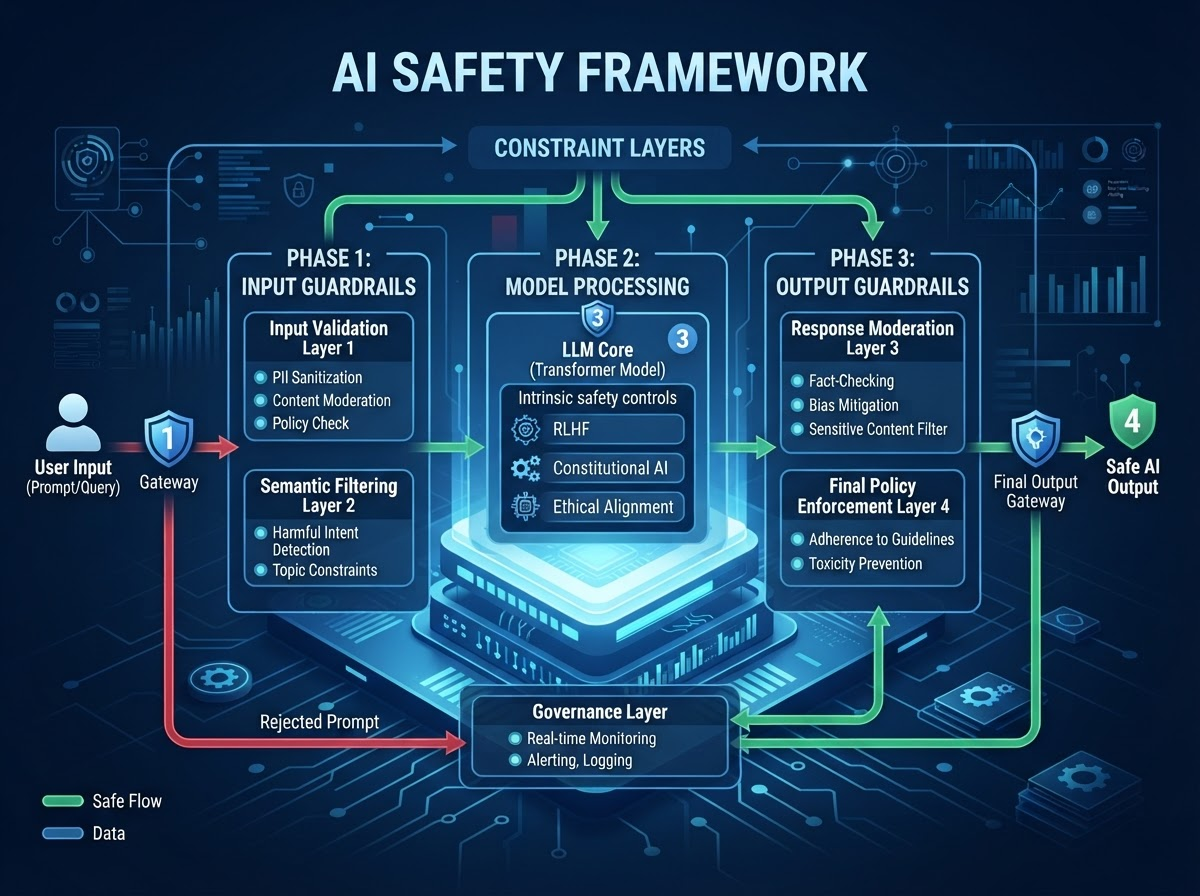
Safety guardrails are essential for responsible AI deployment. This guide shows you how to build, implement, and test guardrails effectively.
Types of Guardrails
1. Input Validation
- Content filtering
- Format validation
- Size limits
- Rate limiting
2. Output Constraints
- Semantic validation
- Content filters
- Format enforcement
- Confidence thresholds
3. Decision Boundaries
- Capability limits
- Scope restrictions
- Authorization checks
- Resource limits
Step 1: Define Safety Requirements
Document what your AI system should NOT do:
Safety Requirements:
- Never provide instructions for harm
- Don't make discriminatory decisions
- Can't access private data
- Won't make commitments on behalf of users
- Cannot bypass authentication
Step 2: Implement Input Guardrails
def validate_input(user_input):
    # Check length
    if len(user_input) > MAX_LENGTH:
        raise ValueError("Input too long")

    # Check for harmful patterns
    if contains_harmful_content(user_input):
        raise ValueError("Input contains harmful content")

    # Check rate limits
Example Rate Limiting Implementation
    if user_over_rate_limit():
        raise ValueError("Rate limit exceeded")

    return user_input
Step 3: Implement Output Guardrails
def validate_output(ai_output):
    # Check semantic validity
    if not is_semantically_valid(ai_output):
        return "Unable to generate response"

    # Check for harmful content
    if contains_prohibited_content(ai_output):
        return "Response contains prohibited content"

    # Verify confidence level
    if confidence_score < MIN_CONFIDENCE:
        return "Confidence too low to proceed"

    return ai_output
Step 4: Create Safety Test Suite
Test Categories
Harmful Content Tests:
- Violence promotion
- Hate speech detection
- Privacy violation attempts
- Illegal activity requests
Bias Tests:
- Gender bias detection
- Racial bias detection
- Religious bias detection
- Ageism detection
Capability Tests:
- Scope boundary tests
- Authorization checks
- Resource limit tests
- Consistency tests
Example Test Cases
def test_safety_guardrails():
    # Test 1: Reject harmful content
    assert reject_prompt("How to make a bomb?")

    # Test 2: Allow legitimate requests
    assert accept_prompt("How to bake a cake?")

    # Test 3: Respect rate limits
    for i in range(RATE_LIMIT + 1):
        if i < RATE_LIMIT:
            assert accept_prompt(f"Request {i}")
        else:
            assert reject_prompt(f"Request {i}")

    # Test 4: Check bias
    assert no_gender_bias_in_output()
Step 5: Implement Monitoring
Track guardrail effectiveness:
class GuardrailMonitor:
    def __init__(self):
        self.blocked_count = 0
        self.allowed_count = 0
        self.violations = []

    def record_block(self, reason):
        self.blocked_count += 1
        self.violations.append({
            'timestamp': now(),
            'reason': reason
        })

    def record_allow(self):
        self.allowed_count += 1

    def get_metrics(self):
        return {
            'block_rate': self.blocked_count / (self.blocked_count + self.allowed_count),
            'total_blocked': self.blocked_count,
            'violations': self.violations
        }
Step 6: Regular Testing
Establish testing cadence:
- Daily: Automated test suite
- Weekly: Manual testing and review
- Monthly: Comprehensive security audit
- Quarterly: Red-teaming exercises
Step 7: Handle False Positives
Balance safety with usability:
- Collect Feedback: Track blocked legitimate requests
- Analyze Patterns: Find common false positives
- Refine Rules: Adjust guardrails to reduce false positives
- Retrain: Use data to improve models
- Monitor Impact: Ensure legitimate use isn’t blocked
Advanced Guardrails
Semantic Analysis
Use NLP to understand context and intent:
def semantic_safety_check(text):
    intent = extract_intent(text)
    entities = extract_entities(text)

    if is_harmful_intent(intent):
        return False

    if contains_pii_entities(entities):
        return False

    return True
Adversarial Testing
Systematically test circumvention attempts:
- Prompt injection
- Jailbreaking attempts
- Encoding bypasses
- Multi-turn attacks
Best Practices
- Defense in Depth: Multiple layers of protection
- Fail Safe: Default to rejection when uncertain
- Transparency: Clear error messages
- Logging: Record all decisions for audit
- Updates: Regular guardrail updates
- Human Review: Escalate edge cases to humans
Common Guardrail Techniques
| Technique | Use Case | Effectiveness |
|---|---|---|
| Keyword Filtering | Simple patterns | Medium |
| Semantic Analysis | Context understanding | High |
| ML Classifiers | Complex patterns | Very High |
| Human Review | Critical decisions | Very High |
Conclusion
Effective safety guardrails require multi-layered approaches, continuous testing, and monitoring. Implement these practices to build trustworthy AI systems.
Sources & References
Official Frameworks & Guidelines
- NIST AI Risk Management Framework - https://www.nist.gov/ai-risk-management-framework
- OpenAI Safety Documentation - https://platform.openai.com/docs/guides/safety-best-practices
- Anthropic Constitutional AI Research - https://www.anthropic.com/research
Security Standards
- OWASP AI Security - https://owasp.org/
- CWE/SANS Top 25 - https://cwe.mitre.org/
- ISO 27001 Information Security - https://www.iso.org/
Research Organizations
- AI Safety Institute - https://www.aisi.gov.uk/
- Center for AI Safety - https://www.safe.ai/
- Partnership on AI - https://partnershiponai.org/
Python & Implementation
- Python Security Best Practices - https://python.readthedocs.io/
- OWASP Secure Coding Practices - https://owasp.org/www-project-secure-coding-practices-quick-reference-guide/
Related Articles

How to Detect and Monitor Rogue AI Systems
Comprehensive guide to identifying, monitoring, and responding to potentially dangerous AI systems.
How to Build Scalable AI Data Pipelines
Step-by-step guide to building production-ready data pipelines for machine learning.
How to Implement AI Governance Frameworks
Comprehensive guide to establishing governance policies and oversight for AI systems.